Swiss Savings Accounts 2026: Best Interest Rates Compared
Do Swiss bank accounts pay interest in 2026? Yes, but not much. The Swiss National Bank kept its policy rate at 0% in its monetary policy assessment of 24 September 2026. The savings accounts in this comparison pay between 0.05% and 0.70%. The top rates come with strings attached: a bonus on new money only, or strict withdrawal limits.
Below you’ll find which of the compared Swiss savings accounts pay the most right now, how bonus rates work, and which account suits an emergency fund.
In short:
- Parking new money for a year: Cler Sparkonto Plus, 0.70% in the first year as long as you don’t withdraw more than CHF 20,000.
- High rate without bonus conditions: Cembra Sparkonto Plus at 0.60%. In return, you can only withdraw CHF 20,000 every 180 days without notice.
- Emergency fund with no withdrawal limit: wiLLBe Tagesgeldkonto. The rate is low at 0.10%, but you can take out everything at any time.
- Bank WIR: the Sparkonto plus is closed to new customers.
Overview: Swiss savings account interest rates compared
All rates are annual rates for Swiss francs.
| Account | CHF rate | Conditions | Withdrawable without notice | Notice period above that |
|---|---|---|---|---|
| Cler Sparkonto Plus | 0.70% in year 1 (0.10% base + 0.60% bonus) | Bonus only on net new money up to CHF 250,000; lost if you withdraw more than CHF 20,000 per bonus period | CHF 50,000 per calendar year | 6 months |
| Cembra Sparkonto Plus | 0.60% | No maximum balance | CHF 20,000 every 180 days | 6 months |
| Cembra Sparkonto | 0.25% | No maximum balance | CHF 20,000 every 90 days | 3 months |
| Zak Sparen (Bank Cler) | 0.20% | Up to CHF 100,000, no interest above | CHF 50,000 per calendar year | 3 months |
| wiLLBe Tagesgeldkonto | 0.10% | Up to CHF 150,000, no interest above | No limit | None |
| Raiffeisen member savings account | Depends on the local bank, e.g. 0.05% | Membership required; lower rate from CHF 100,000 | E.g. CHF 10,000 or CHF 20,000 within 30 days | E.g. 91 days |
| Bank WIR Sparkonto plus | 0.60% until 31 March 2027 | Existing customers only; up to CHF 250,000 | CHF 20,000 per calendar year | 180 days |
If you withdraw more than the free allowance without giving notice, WIR, Cler, Zak, Cembra and the Raiffeisen banks we checked charge 2% on the amount above the allowance. At Raiffeisen, that’s only possible if the bank allows the early withdrawal at all.
Do Swiss bank accounts pay interest?
Classic savings accounts pay a small rate. Many app accounts pay nothing: Neon pays no interest on balances, and Yuh currently pays 0% on savings projects in CHF, EUR and USD.
Savings rates depend on the SNB’s policy rate. But each bank decides how much it passes on, which is why comparing is worth it.
Ordinary rate or bonus rate: what to watch out for
The highest rate in a table is often not the rate you’ll earn for long. There are three kinds:
- Ordinary rate: applies to your whole balance until the bank changes it. Example: Cembra Sparkonto Plus at 0.60%.
- Bonus rate on new money: applies only to money that’s new to the bank, and only for a set period. Example: Cler pays a 0.10% base rate plus a 0.60% bonus. Withdraw too much and you lose the bonus for the whole period.
- Guaranteed promotional rate: a fixed rate until a cut-off date, after which a different product applies. Example: Bank WIR’s Sparkonto plus turns into the Treue-Sparkonto at currently 0.30% when it expires.
Interest caps matter too. wiLLBe pays nothing on balances above CHF 150,000, and Zak pays nothing above CHF 100,000. A high rate only helps if your balance and your need for withdrawals fit the conditions.
Cler Sparkonto Plus: 0.70% in year one, on new money only
Bank Cler’s Sparkonto Plus currently pays a 0.10% base rate plus a 0.60% bonus, so 0.70% in total. Here’s how the bonus works:
- In the first year after opening, the bonus applies to net new money: deposits minus withdrawals.
- After that, new net deposits earn the bonus until the end of the calendar year.
- New money up to CHF 250,000 qualifies. Transfers from other Cler savings accounts don’t.
- Money you withdraw in the last month of the year and pay back in during the first three months of the next year doesn’t count either.
Opening the account, account maintenance and digital banking are free. You can withdraw CHF 50,000 per calendar year without notice. Larger amounts require six months’ notice.
Disadvantages of the Cler Sparkonto Plus
There are two limits that are easy to mix up. You can withdraw CHF 50,000 per year without notice. But you lose the bonus as soon as you withdraw more than CHF 20,000 per bonus period, and you lose it for the entire period. Giving notice with a withdrawal date within 180 days after the end of a bonus period also costs you that period’s bonus. On top of that, Cler charges a CHF 3 surcharge for payments made directly from the savings account. Transfers to your own account at Cler are free, so pay from there instead.
Cembra Sparkonto Plus and Sparkonto: high rate, tight limits

Cembra Money Bank is mainly known for its credit cards, but as a licensed Swiss bank it also offers savings products. We look at two of its savings accounts here. For both, opening, maintenance, bookings and closing are free, there’s no maximum balance, and you earn interest from the first franc.
Sparkonto Plus: 0.60% per year. You can withdraw CHF 20,000 every 180 days without notice; larger amounts require 6 months’ notice.
Sparkonto: 0.25% per year. Here CHF 20,000 every 90 days is free; larger amounts require 3 months’ notice.
The rates are variable, and Cembra can change them at any time.
Disadvantages of the Cembra savings accounts
With the Sparkonto Plus, you pay for the higher rate with flexibility. More than CHF 20,000 in six months is only available with six months’ notice or a 2% charge on the excess. That’s a poor fit for an emergency fund larger than CHF 20,000.
Zak Sparen: 0.20% up to CHF 100,000
Zak is Bank Cler’s app-based bank. Its “Zak Sparen” plug-in pays 0.20% up to CHF 100,000 and 0% above that. Maintenance is free. You can withdraw CHF 50,000 per calendar year without notice; above that, three months’ notice applies.
Disadvantages of Zak
Balances above CHF 100,000 earn nothing. And because Zak belongs to Bank Cler, your balances at Zak and Cler count together for deposit protection.
wiLLBe Tagesgeldkonto: no withdrawal limit
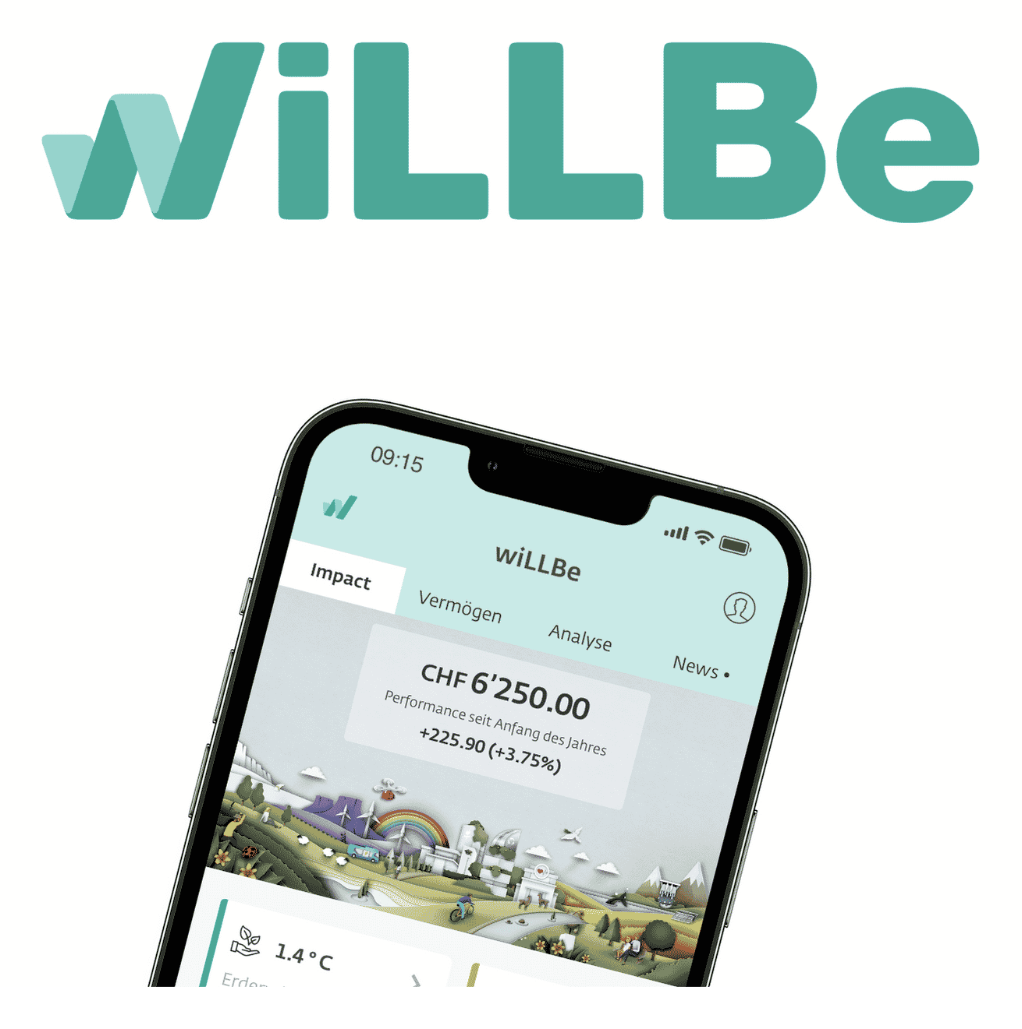
wiLLBe is the investment app of Liechtensteinische Landesbank (LLB). Besides investment products such as ETFs and gold, it offers an instant-access savings account, the Tagesgeldkonto. Rates are variable and the same for new and existing customers:
| Currency | Rate | Paid up to |
|---|---|---|
| CHF | 0.10% | CHF 150,000 |
| EUR | 2.40% | EUR 150,000 |
| USD | 3.25% | USD 150,000 |
Balances above the cap earn no interest. There’s no withdrawal limit, no maximum deposit and no account fee. wiLLBe charges no fee of its own for withdrawals, but foreign charges can apply to transfers in USD or GBP. Interest is credited at the end of each quarter. You can only open the account through the app; after that, browser access is available too.
Disadvantages of wiLLBe
The franc rate is low at 0.10%. The higher euro and dollar rates look tempting, but they don’t guarantee a higher return in francs: exchange-rate losses can wipe out the interest advantage, as wiLLBe itself points out. Historically, the Swiss franc has appreciated against the euro and the dollar. “Available at any time” also doesn’t mean instantly: a transfer to your main account takes about 2–3 working days. wiLLBe isn’t a Swiss bank, so Liechtenstein’s deposit protection applies (more below).
Raiffeisen member savings account: convenient, but often a low rate

Raiffeisen is Switzerland’s second-largest banking group. For the member savings account (Mitglieder-Sparkonto), you need to become a member by buying a share certificate from your local Raiffeisen bank. Members get voting rights and discounted banking products, among other things. The share price depends on the bank: CHF 500 at Raiffeisenbank Zürich, CHF 200 at Raiffeisenbank Zürich Flughafen.
There’s no single national rate: each Raiffeisen bank sets its own terms. Two examples from Locarno and Obwalden:
| Raiffeisenbank Locarno | Raiffeisenbank Obwalden | |
|---|---|---|
| Member savings rate | 0.05% | 0.05% |
| From CHF 100,000 | 0.025% | 0.025% |
| Withdrawable without notice | CHF 10,000 within 30 days | CHF 20,000 within 30 days |
| Notice period above that | 91 days | 91 days |
In Obwalden, account maintenance is free.
Disadvantages of the Raiffeisen member savings account
Both examples pay 0.05%, well below Cler or Cembra, and you also need to buy the share certificate.
Bank WIR Sparkonto plus: closed to new customers

Bank WIR’s Sparkonto plus is closed to new customers.
Existing accounts earn 0.60% until 31 March 2027 on balances up to CHF 250,000 and 0.025% above that. CHF 20,000 per calendar year can be withdrawn freely; more requires 180 days’ notice. When the term ends, the account automatically becomes a Treue-Sparkonto paying currently 0.30% up to CHF 500,000. If you withdraw more than CHF 20,000 in a year there, your entire balance earns only the ordinary savings rate of 0.05% for that year.
Disadvantages of Bank WIR
For new money, WIR isn’t an option. If you have a Sparkonto plus, check before your term ends whether 0.30% in the Treue-Sparkonto still makes sense for you. External transfers from WIR savings accounts cost CHF 2 per payment.
What about neobanks?
- Neon: no interest. More in my Neon review.
- Yuh: currently 0% on savings projects in CHF, EUR and USD.
- Zak: 0.20% up to CHF 100,000, see above.
- Radicant: not in this comparison. Radicant is ending its banking business, and esisuisse lists it as winding down. There’s an agreement with Alpian for Radicant customers. More in my Radicant review.
Example: interest on CHF 20,000 over one year
What do the differences mean in francs? Assumptions:
- You deposit CHF 20,000 of new money on 1 January and leave it for a year with no withdrawals.
- Rates stay the same for the whole year.
- Gross interest, no compounding, before tax.
- At Cler, you’re in your first account year and meet the bonus conditions.
| Account | Rate | Interest after one year |
|---|---|---|
| Cler Sparkonto Plus (year 1) | 0.70% | CHF 140 |
| Cembra Sparkonto Plus | 0.60% | CHF 120 |
| Cembra Sparkonto | 0.25% | CHF 50 |
| Zak Sparen | 0.20% | CHF 40 |
| wiLLBe Tagesgeldkonto | 0.10% | CHF 20 |
| Raiffeisen (Locarno/Obwalden example) | 0.05% | CHF 10 |
In this example, the gap between the best and the worst account is CHF 130 a year. At Cler, the 35% withholding tax is only deducted if gross interest exceeds CHF 200, which CHF 140 doesn’t. If you withdraw more than CHF 20,000 from Cler during the year, the bonus is gone and you’re left with 0.10%.
Which savings account is best for an emergency fund?
To me, a savings account isn’t a tool for building wealth. It’s a place for money you’ll need soon or unexpectedly. Budgetberatung Schweiz recommends three to six months’ income as an emergency fund for single-person households. Why this step comes before investing is covered in my path to wealth article.
For an emergency fund, access matters more than the last tenth of a percentage point:
- Is your emergency fund larger than CHF 20,000? Then the free allowance at Cembra Sparkonto Plus or WIR won’t cover a real emergency. Cler and Zak allow CHF 50,000 a year, and wiLLBe has no limit.
- Do you need the money fast? No limit doesn’t mean instant: at wiLLBe, a transfer to your main account takes about 2–3 working days. You may want to keep part of your emergency fund in your everyday account.
- Want to keep the bonus? At Cler, a withdrawal above CHF 20,000 costs you the bonus for the whole period.
The same applies if you suddenly receive a large sum, for example from an inheritance or a home sale, and want time to decide what to do with it. Watch the withdrawal limits, and remember that deposit protection only covers CHF 100,000 per bank. If you’re sure you won’t need part of it for two years or more, fixed-term deposits and medium-term notes pay a fixed rate for the whole term.
Is my money in a savings account safe?
Up to a limit, yes. Swiss deposit protection is run by esisuisse, a private association of banks. FINMA is the supervisor but doesn’t insure deposits itself. Protection covers CHF 100,000 per client and bank. All your accounts at the same bank are added together. Bank WIR, Bank Cler, Cembra and Raiffeisen are listed in the esisuisse register.
Two more details:
- Each Raiffeisen bank is a separate bank, so the limit applies per Raiffeisen bank, not per branch.
- App accounts count at the bank behind them: Zak at Bank Cler, Neon at Hypothekarbank Lenzburg, Yuh at Swissquote.
For wiLLBe, Liechtenstein’s deposit protection applies: CHF 100,000 per person and bank, with all accounts added together. LLB has no state guarantee.
Conclusion: the best Swiss savings account in 2026
There’s no single best savings account. It depends on what the money is for:
- You have new money and won’t need it for a year: Cler Sparkonto Plus. 0.70% in the first year, as long as you withdraw no more than CHF 20,000.
- You want a high rate without bonus rules: Cembra Sparkonto Plus at 0.60%, if CHF 20,000 every 180 days is enough for you.
- You need an account for your emergency fund: wiLLBe with no withdrawal limit, or Zak with CHF 50,000 a year. The rate is lower, but you can get to your money.
- You’re already a Raiffeisen member: convenient in the same e-banking, but the rate depends on your bank. In our examples it’s 0.05%.
- You have a WIR Sparkonto plus: keep it until the guaranteed term ends, then compare the 0.30% Treue-Sparkonto with the offers above.
Savings rates change often.